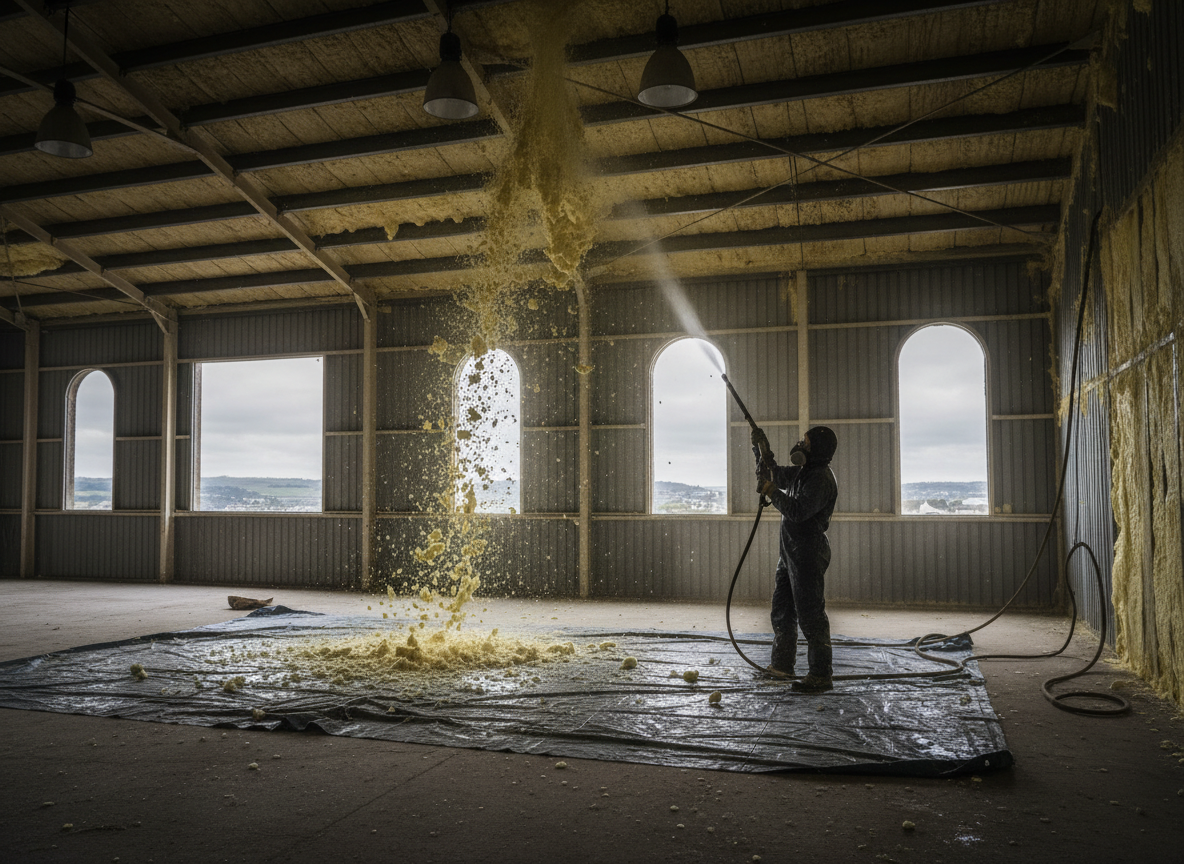
Warehouses in Torquay and the surrounding Devon coast often feature spray foam applied decades ago over brick or metal cladding. Removing it requires isolating large open volumes, managing dust migration into adjacent units, and dealing with foam that has absorbed salt-laden air which makes it brittle in places and rubbery in others. Crews start by sectioning the roof and wall planes, using negative-pressure containment to prevent particles drifting into storage areas still in use.
Edge cases appear when foam was sprayed over original bitumen coatings or early insulation boards common in pre-1970s Torquay warehouses. These layers can release fibres or adhesives that must be separated before disposal under Devon waste regulations. Access is frequently limited to single roller doors, so equipment is broken down and carried in rather than craned, adding time but protecting the structure from further damage.
Ventilation paths in these buildings run through ridge vents and high-level windows that draw in sea air; any remaining foam residue quickly re-absorbs moisture and re-adheres if not fully cleared. Final verification involves moisture metering across the substrate and a visual sweep under bright task lighting to confirm no pockets remain behind purlins or girts.
Regulatory and Disposal Notes
UK waste classification for removed polyurethane foam requires separate bagging and licensed haulage. Torquay operators route material through local Devon transfer stations rather than landfill where possible, keeping paperwork on site for the warehouse manager.
Technician insight
In Torquay the thing that catches most people out with warehouse spray foam removal is the way salt air has hardened the outer skin while leaving the inner layer soft and sticky against the original metal or brick. That forces slower, layered scraping rather than one-pass removal, especially on buildings near the harbour where wind-driven moisture has penetrated the foam for years.
Harbour-Side Warehouse Foam Strip
Foam on a 1960s steel-frame warehouse near Torquay harbour had absorbed repeated sea mist and begun detaching in sheets. Survey showed adhesive still bonded behind purlins where coastal humidity kept it pliable. Crews ran negative pressure across the full volume, removed foam in sections, cleaned residue, and cleared the site within three days without halting tenant storage access.
How it works
- 1
Site Survey and Containment Planning
Walk the warehouse floor and roof structure in Torquay to map foam thickness, substrate type, and existing ventilation routes before setting up sealed zones.
- 2
Mechanical Removal and Vacuum Extraction
Scrape and cut foam in controlled passes, feeding debris directly into sealed extraction units to limit airborne particles inside the building.
- 3
Substrate Cleaning and Inspection
Remove residual adhesive films, check for hidden damp patches common near Torquay's coastal exposure, and confirm the surface is ready for any follow-on works.
- 4
Waste Segregation and Off-Site Removal
Bag classified waste on site, load for licensed Devon disposal, and leave the warehouse clear for immediate re-use or re-insulation.
Pricing
Cost depends on warehouse floor area, foam depth, and access restrictions; 24/7 availability allows scheduling around operations.