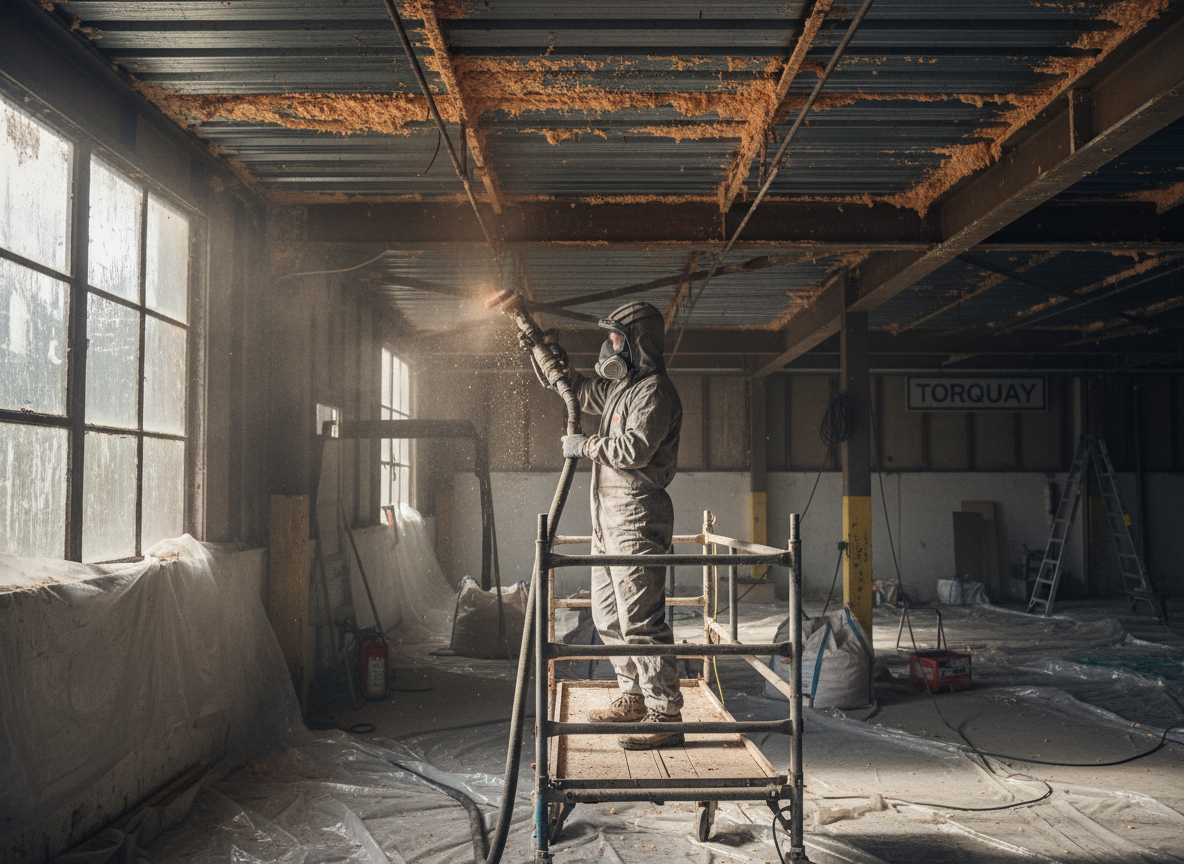
Commercial properties in Torquay often feature older masonry or timber-frame construction common to the area’s Victorian and Edwardian stock. Removing spray foam from these buildings requires careful separation of the foam from brick, stone or lath without damaging original fabric that may already be compromised by decades of coastal exposure. Edge cases include foam applied directly over electrical runs or pipework in retail units along the harbour front, where heat build-up and hidden voids create extra fire and access risks during extraction.
Devon’s frequent driving rain and mild but persistently damp winters mean commercial roofs and walls in Torquay retain higher moisture levels than inland sites. This moisture binds foam more tightly to substrates, increasing the chance of substrate tearing if pull tests and staged removal techniques are not used. Operators must also manage dust and debris containment on multi-tenanted sites where trading cannot stop, using sealed corridors and negative-air setups suited to narrow town-centre access.
Local planning and building-control expectations in the Torquay area require that any disturbance of insulation in commercial premises is followed by verification that the remaining structure meets current thermal and fire standards. Failure to document this step can delay re-occupation or insurance sign-off, especially for listed or conservation-area buildings around the town centre and Babbacombe.
Crew safety on commercial jobs here centres on working at height on pitched slate roofs typical of Torquay terraces and managing tidal timing when waste skips must be collected from harbourside premises. All arisings are removed from site the same day to avoid storage issues on constrained urban plots.
Technician insight
In Torquay, the thing that catches most people out with Commercial Spray Foam Removal is how the salt-laden air along the seafront makes foam bond tighter to stone and render than it does on inland Devon buildings, so you end up doing more hand work and less machine work on harbour-side units.
Harbour-side retail unit
Foam in a Torquay shop ceiling had been applied over old lath and electrical cabling. We found saturated sections near a leaking valley gutter. Extraction was done in sections with full containment so the business stayed open; all waste left site the same day and the ceiling was left ready for new insulation.
How it works
- 1
Site Assessment
Walk-through of the commercial premises to map foam locations, check for hidden services and note access constraints typical of Torquay town-centre buildings.
- 2
Containment Setup
Installation of dust barriers, negative-air machines and floor protection to keep trading areas operational during works.
- 3
Controlled Extraction
Layered removal using manual and mechanical methods suited to the substrate, with ongoing monitoring for moisture or structural surprises.
- 4
Clearance and Verification
Full debris removal, surface cleaning and handover documentation confirming the space is ready for follow-on trades or re-insulation.
Pricing
Cost depends on foam thickness, building access and whether trading must continue; site visit required for accurate scope.