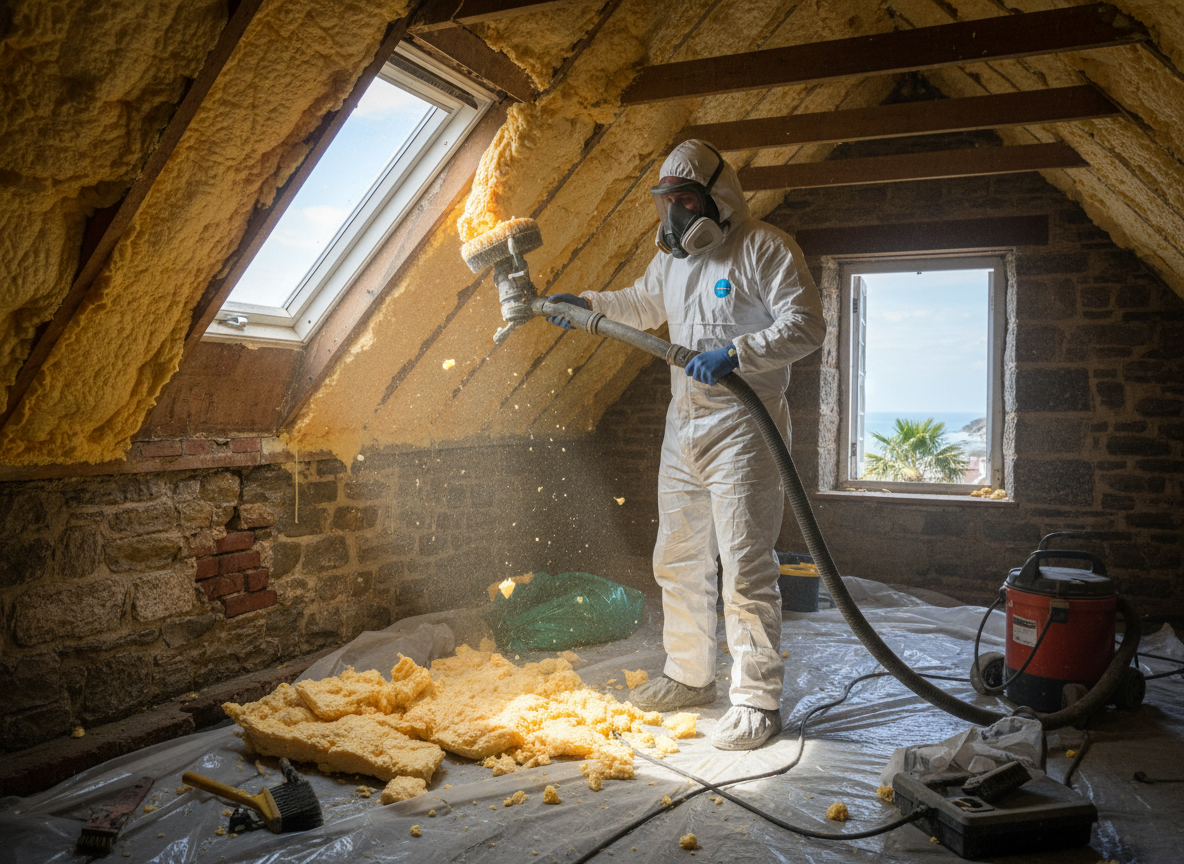
Torquay’s older housing stock, particularly the Victorian and Edwardian terraces around The Terrace and Babbacombe, often received spray foam insulation in the 1990s and 2000s. The foam bonds tightly to rafters and slate undersides, and the region’s frequent driving rain and high humidity mean any trapped moisture quickly leads to timber decay. Removing it requires careful cutting in sections rather than pulling, to avoid dislodging loose slates or disturbing original lath and plaster ceilings below.
Edge cases appear regularly in post-war bungalows on the hills above Torquay harbour where foam was sprayed over existing mineral wool. The combination creates hidden condensation pockets that only become visible once the foam is peeled back. In these properties we work from the loft side only, using negative-pressure extraction to keep dust out of living spaces, and we always check for original ventilation gaps that were blocked during the original installation.
Devon building control now requires clear ventilation paths in lofts after foam removal. We restore airflow by fitting new eaves vents and ridge vents where original ones were covered, and we leave the space ready for reinsulation with breathable materials. Homeowners in coastal streets such as those near Meadfoot Beach see faster results because salt-laden air accelerates any remaining damp once the impermeable layer is gone.
Technician insight
In Torquay, the thing that catches most people out with loft spray foam removal is how quickly salt air and driving rain push moisture into rafters once the foam is stripped. Victorian terraces near the harbour often have blocked original vents that homeowners never knew existed until the foam comes off.
Foam Removal in a Torquay Terrace Loft
A 1900s house near The Terrace showed persistent musty smells after heavy winter rain. Inspection found closed-cell foam had sealed over rotted eaves timbers. We removed the foam in sections, replaced two damaged rafter ends, and reopened the original ventilation gaps. The loft now stays dry through the wet season.
How it works
- 1
Site Survey and Access Check
We inspect the loft from 36 The Terrace base, checking rafter condition, existing vents, and safe access routes through typical Torquay terrace hatches.
- 2
Sectional Foam Removal
Foam is cut into manageable pieces using oscillating tools to limit vibration on older slate roofs common in the area.
- 3
Debris Extraction and Cleaning
All material is removed via vacuum and bagged on site, with dust containment to protect rooms below in multi-storey homes.
- 4
Ventilation Restoration
Original eaves and ridge vents are cleared or new ones installed to suit Devon’s damp climate before handover.
Pricing
Upfront quotes after inspection; final cost depends on loft size, foam depth and access difficulty in older Torquay properties.