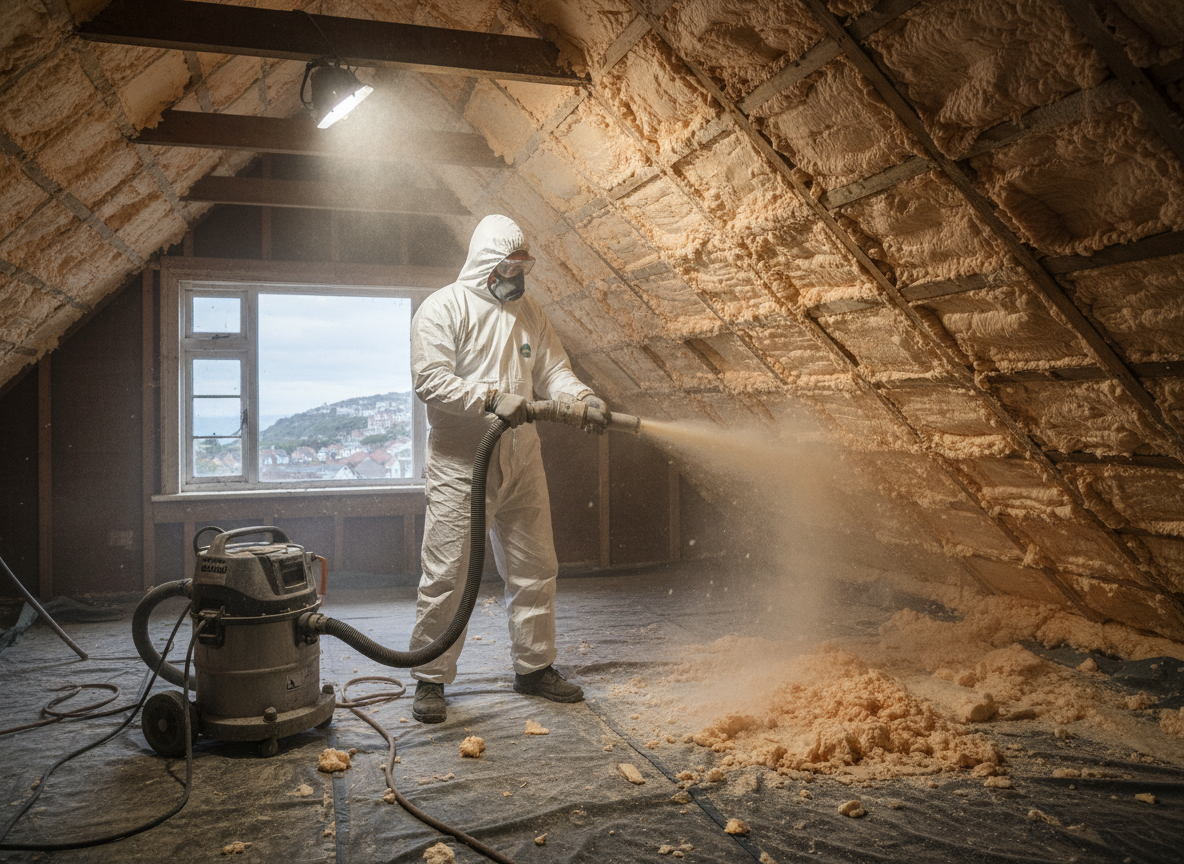
Closed cell spray foam bonds tightly to timber and masonry in Torquay's older stock, especially the Victorian terraces around The Terrace and Ellacombe. Once installed it can trap moisture against rafters when sea-driven rain finds its way through ageing slate roofs, leading to rot that only becomes visible after several winters. Removal requires cutting the foam into manageable sections while protecting lath and plaster ceilings below and avoiding damage to original roof timbers that are often irregular in size.
The work typically starts with negative-pressure containment to stop foam dust drifting into living spaces. In properties near the harbour or along the seafront the salt content in the air means any exposed metal fixings must be checked and treated immediately after foam is stripped, otherwise corrosion sets in within weeks. Technicians also watch for hidden electrical cables and pipework that were routed through the foam during the original installation.
Disposal follows strict waste rules because closed cell foam is classed as non-hazardous but bulky. All removed material is bagged on site and taken to the Newton Abbot recycling facility rather than left in Torquay skips. After removal the roof void is left ventilated so the timber can dry before any new insulation is considered.
Homeowners in Babbacombe and St Marychurch often discover the foam was applied over existing mineral wool, creating a double layer that holds water against the ceiling joists. In these cases the lower layer must be removed first to reach the closed cell material without collapsing the ceiling.
Technician insight
In Torquay, the thing that catches most people out with closed cell spray foam removal is how quickly salt-laden air from the bay starts corroding the original iron nails once the foam is stripped from the rafters in those 1890s terraces around Torre Abbey.
Foam removal in a St Marychurch terrace
Closed cell foam had been sprayed over the original mineral wool in a 1930s roof. Water had been sitting against the joists for two winters. We cut out the foam in sections, treated the corroded fixings, and ventilated the void so the timber could dry before any further work.
How it works
- 1
Site Assessment
Inspect the roof void or wall cavities in the Torquay property to confirm closed cell foam depth and check for hidden services or rot.
- 2
Containment Setup
Seal the work area with sheeting and negative air units to keep dust out of living spaces below.
- 3
Foam Extraction
Cut the foam into sections and remove it by hand, taking care not to damage original rafters or masonry in period homes.
- 4
Clean and Treat
Vacuum residues, treat any exposed metal for salt corrosion, and ventilate the void to allow drying.
- 5
Waste Removal
Bag all material and transport it to the approved Devon recycling site, leaving the property ready for inspection.
Pricing
Price depends on access, depth of foam, and whether multiple roof voids are involved. Quotes are given after an on-site visit.